IWD: The Mothers Who Invented Survival Cooking

Every March, the internet gives us glossy roundups of famous women in food. And listen, I love a powerhouse chef as much as anyone.
But for International Women's Day on March 8, I'm thinking about a different kind of culinary legend: the women who could look at half a cabbage, a bag of noodles, and a nearly-empty butter tub and still put dinner on the table for five people.
No applause. No fancy kitchen. No "quick trip" to a specialty market.
Just pure survival skill.
That is women in cooking, too.
I didn't fully understand this until I became a mom of three and started tracking grocery prices like it was my second job. I hit my breaking point one night after spending way too much on a "nice" dinner, only to watch it get picked apart by tiny critics who wanted ketchup and chaos.
That week, I went back to my grandma's food.
At first I called it comfort food. Then I called it what it actually was: budget engineering in an apron.
My grandma never said "macros," "meal prep," or "food waste reduction." She just knew how to stretch ingredients so nobody went to bed hungry. She knew which meals could handle substitutions when money was tight. She knew how to make a pan look full, taste rich, and leave enough for lunch.
That wisdom gets treated like "old-fashioned cooking," but let's be honest: these were survival meals. Generational, practical, and brilliant.
A lot of us learned them without realizing it.
You saw it in the way moms and grandmothers saved bacon fat, revived leftovers, and made "nothing in the house" nights somehow work out. You saw it in casseroles that fed extra cousins. You saw it in soups that got one more cup of water and one more potato and still tasted like home.
This isn't a cute nostalgia post. This is me saying those women were financial strategists with wooden spoons.
And one of my favorite examples is still my weeknight hero:
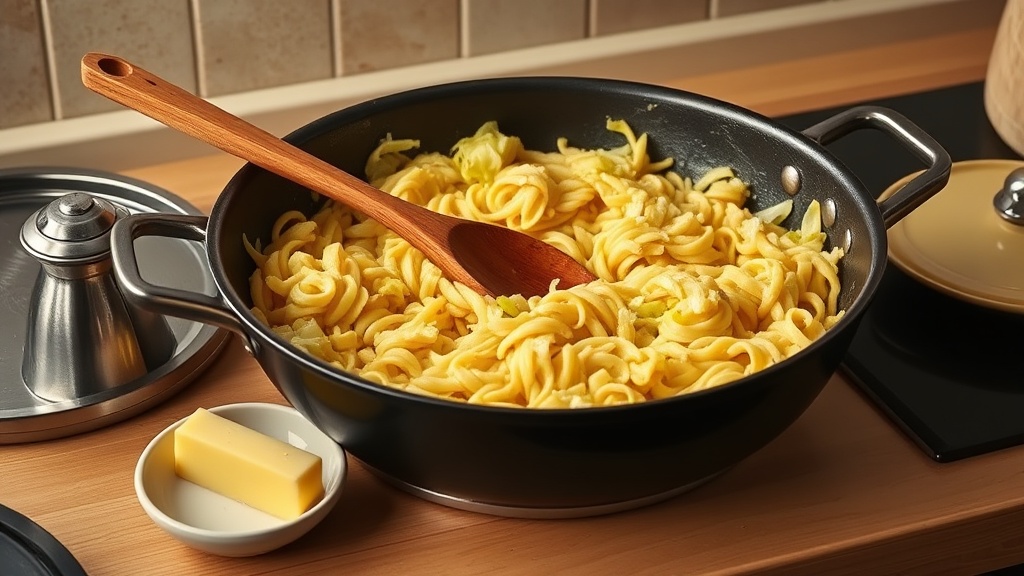
Cabbage and Egg Noodles (Haluski-Style)
This is one of those easy recipes that sounds too simple to work. Then you make it, and suddenly everyone is full and quiet for at least seven minutes.
Why it works
- Three main ingredients
- 20 minutes, start to finish
- Filling enough for a family dinner
- Flexible: can run cheap with pantry fat, or richer with real butter
Price reality check (Columbus, Ohio, March 6, 2026)
I re-checked this before publishing using Aldi same-day listings, and prices are higher than the old "$4 total" claim in many stores.
- Cabbage (about 3 lb): $2.55 each (est.)
- Egg noodles (16 oz): $1.95
- Butter (16 oz): $3.55
If you had to buy all three that day, you're closer to $8.05 out of pocket.
But this recipe only uses about 3 to 4 tablespoons of butter (not the whole box). Costing by what you actually use, this pan lands around $4.80 to $5.30 in my Columbus math this week.
Real life note: this can swing fast by store, sales, and whether your cabbage is priced per head or per pound. Re-check your local app/flyer the day you shop.
Ingredients
- 1 small green cabbage, thinly sliced
- 12 to 16 oz egg noodles
- 3 to 4 tablespoons butter or margarine
- Salt and black pepper to taste
Optional if you have them: onion, garlic powder, pinch of paprika.
How I make it (20 minutes)
- Bring salted water to a boil and cook egg noodles until just tender. Drain.
- While noodles cook, melt butter in a large skillet over medium heat.
- Add cabbage with a pinch of salt. Cook 8 to 10 minutes, stirring, until softened and lightly golden at the edges.
- Add drained noodles to the skillet and toss everything together for 2 to 3 minutes so the noodles soak up that buttery cabbage flavor.
- Season with pepper and more salt if needed.
If I need to stretch it further, I serve it with applesauce, a fried egg, or a piece of toast. Not glamorous. Very effective.
And that's the point.
This International Women's Day, I'm celebrating the women who made dinner happen when the budget said "absolutely not." The moms who could turn pennies into portions. The grandmothers who taught us that resourcefulness is its own kind of art.
If you're in a hard grocery season right now, I want you to hear this from me clearly: feeding your family with simple, cheap, repeatable meals is not "less than." It is skill. It is care. It is leadership.
So here's to the women who invented survival cooking before anybody gave it a name.
May your cabbage be on sale, your noodles never stick, and your kids eat without negotiating a hostage treaty.