
The Invisible Work: What International Women's Day Looks Like in My Kitchen

Listen, International Women's Day is March 8, and nobody's throwing me a parade for the mashed potato fort incident—or for the 47 dinners I've planned since Tuesday.
Not a parade. Not a gift card. Not even a "nice job, the children are still alive." Just another Thursday where I'm standing in the Aldi aisle at 5:17 PM, quarter ready, with my four-year-old attempting to bite the head off a seasonal display gnome while I calculate whether I can stretch a pound of ground turkey into dinner for five.
This is the invisible work. And International Women's Day is actually a good time to just—say that out loud.
The Math Nobody Talks About
Here's what I tracked last spring when I got obsessive about it: I spent an average of 6.5 hours per week planning, shopping, prepping, and cooking for my family. Not eating. Not cleaning up. Just the logistics of getting food into the house and onto the table.
That's 338 hours a year. More than eight full work weeks.
No overtime. No performance review. No LinkedIn post about it.
The USDA's Thrifty Food Plan for a family of five (per January 2025 figures) runs roughly $950–$1,000/month—about $220–$235/week. That's the federal government's own floor for bare minimum. I've been running about $195–$210/week here in Columbus, which means I'm actually coming in below that floor—and that's with three kids who have opinions. (My seven-year-old has opinions about sauce touching noodles. My nine-year-old has recently decided she's "not really a fan of dinner." My four-year-old will eat a crayon but won't eat cheese.)
Nobody puts "emotional labor of feeding picky humans on a budget" on a resume. It doesn't show up in any "women's empowerment in the kitchen" article that wants to sell you a $300 dutch oven.
So let's talk about what it actually looks like.
Three Real Dinners for Under $2/Serving
These aren't my most Instagrammable meals. They're my most repeated meals—the ones I can execute on zero sleep, with background chaos, and still get food on the table before anyone cries. Myself included.
(Prices are what I paid at my Columbus, Ohio Aldi in early March 2026. Your mileage will vary by store and week.)
1. Smashed Bean Quesadillas
Total cost: ~$4.80 for five servings ($0.96/serving)
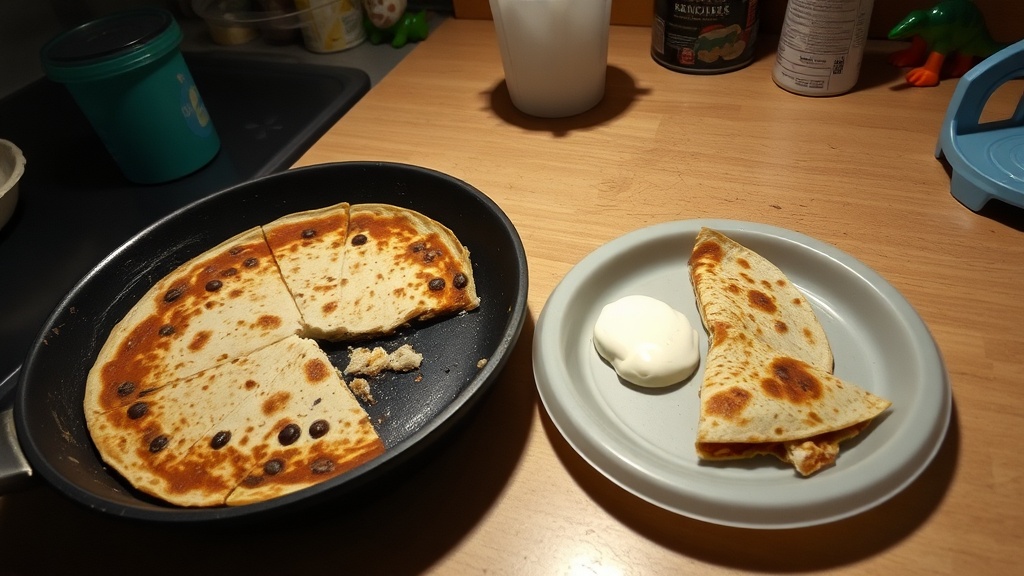
One can of black beans ($0.79), mashed with cumin and a pinch of garlic powder. Spread across four flour tortillas ($1.29 for the pack). Shredded cheddar on half ($1.49 for the bag, use about a third). Fold, press in a dry skillet for two minutes a side.
Serve with jarred salsa ($0.89 on sale, lasts weeks) or sour cream if I'm feeling extravagant.
My kids call these "black bean tacos" and request them. That is, genuinely, a miracle.
Time: 12 minutes. Dishes: one skillet, one fork for mashing.
2. Buttered Egg Noodles with Frozen Peas and Turkey Sausage
Total cost: ~$6.20 for five servings ($1.24/serving)
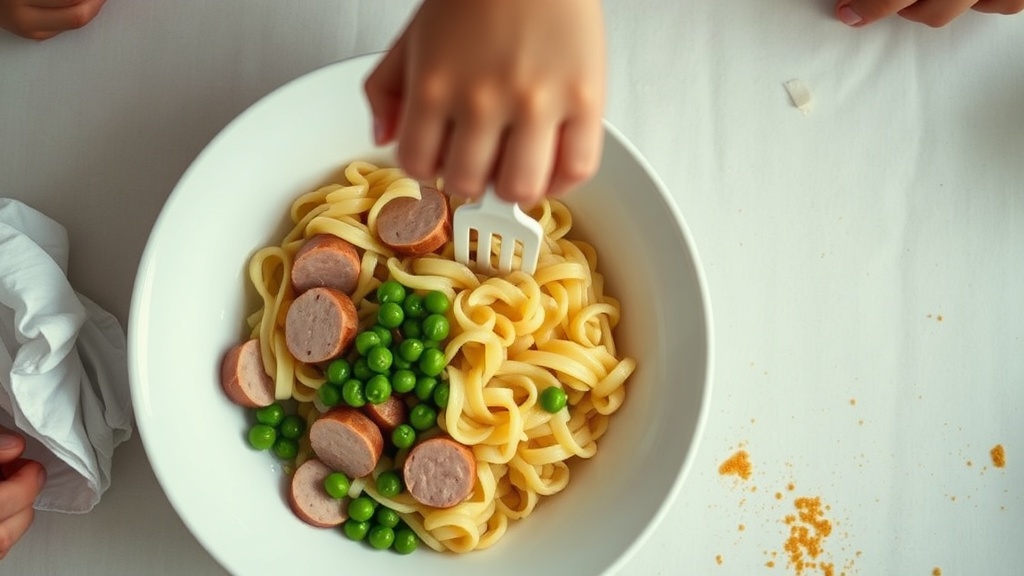
Egg noodles are one of the last things that are still genuinely cheap ($1.19/bag at my Aldi this week). Half a pack of turkey smoked sausage ($2.49, sliced into coins), a cup of frozen peas (pennies from a $1.29 bag), two tablespoons of butter, salt, and a lot of black pepper.
Cook the noodles. While they're going, brown the sausage coins in a skillet. Drain the noodles, toss with butter, add peas (they'll thaw in about ninety seconds from the noodle heat), add sausage.
My nine-year-old asked for seconds last time. I almost took a photo. I didn't, because my phone was dead and also because that's not what this is about.
Time: 18 minutes.
3. Scrambled Egg Bowls with Whatever's Left
Total cost: ~$3.50 for five servings ($0.70/serving)
This is the "what do we have" dinner. Six eggs ($1.59 right now, finally), whatever cheese exists, whatever leftover vegetable is in the fridge (last week: half a zucchini and some sad bell pepper), served over toast or rice if I have it.
Everyone gets a bowl. I scramble in batches because my skillet isn't big enough for a family of five in one go. Nobody cares about presentation. We eat it.
This is also my most nutritionally complete cheap meal. Eggs have protein, fat, and micronutrients. Vegetables add fiber. It's fine. It's more than fine.
Time: 15 minutes.
The Budget Reality
Can you make "healthy quick meals" for $8?
Yes and no. Here's the honest version:
What $8 actually buys: One of the dinners above, with a little left over. Or a bag of chicken thighs that you can stretch two nights. Or ingredients for a big pot of soup with whatever's already in the pantry.
What $8 does not buy: The aspirational "clean eating" dinner with organic everything, a grain bowl base, and three artisan toppings from the fancy grocery store. That's not a budget dinner. That's a budget line item on a $65 receipt.
I am not anti-nutrition. I want my kids to eat real food. But I am deeply, profoundly anti-shame about the reality of feeding a family when money is tight. Frozen vegetables are fine. Canned beans are fine. Eggs are one of the most nutritionally dense cheap foods on the planet. "Healthy" does not require a $14 bottle of tahini.
The women I know who are actually feeding their families on $50/week aren't doing it with Meal Prep Sunday and matching glass containers. They're doing it with a mental rotation of eight dinners they know will get eaten, a quarterly Costco run when they can swing it, and the ability to look at the last three things in the fridge and make a meal without a recipe.
That's the skill. That's the work. It's invisible, and it's real.
No Apologies
Your kids will survive nuggets and frozen peas. They will survive a week where three out of five dinners came from a box. You are not failing because you didn't make hand-rolled pasta on a Tuesday after work.
You don't need the dutch oven. You don't need organic anything (unless it's genuinely in budget—then, great). You don't need to feel "empowered" in the kitchen—you need dinner to happen without a total collapse, and that is a completely legitimate and worthy goal.
What I will say, on the eve of International Women's Day, is this: the work of feeding families is overwhelmingly done by women, it is chronically underpaid when it's paid at all, and it is almost entirely invisible when it happens inside someone's own home. The mental load of knowing what's in the fridge, what everyone will actually eat, what's on sale this week, and how to make it all work—that's real cognitive labor, and it deserves to be named as such.
Not to make it feel heavier. Just to make it feel seen.
Happy Women's Day. You're doing great. Now let's eat.
Have a framework that works for your family? Tell me in the comments — I'm always looking for what's actually working in real kitchens.